Recycling
There is campus-wide sorting facility that can deal with a lot of the waste produced in the lab, you can join the effort by requesting specific bins to dispose of paper and many recyclable plastics amongst others, all the information in this link.
In particular,
Gloves
UBC does not offer it campus-wide for now, so, we are running a small-scale effort in collaboration with botany, zoology and teaching labs (this includes our building plus the Biosciences building).


Please contact natalia.bercovich@botany.ubc.ca or jacelyn@zoology.ubc.ca for any questions/updates on this information.
Soft Plastics & Styrofoam
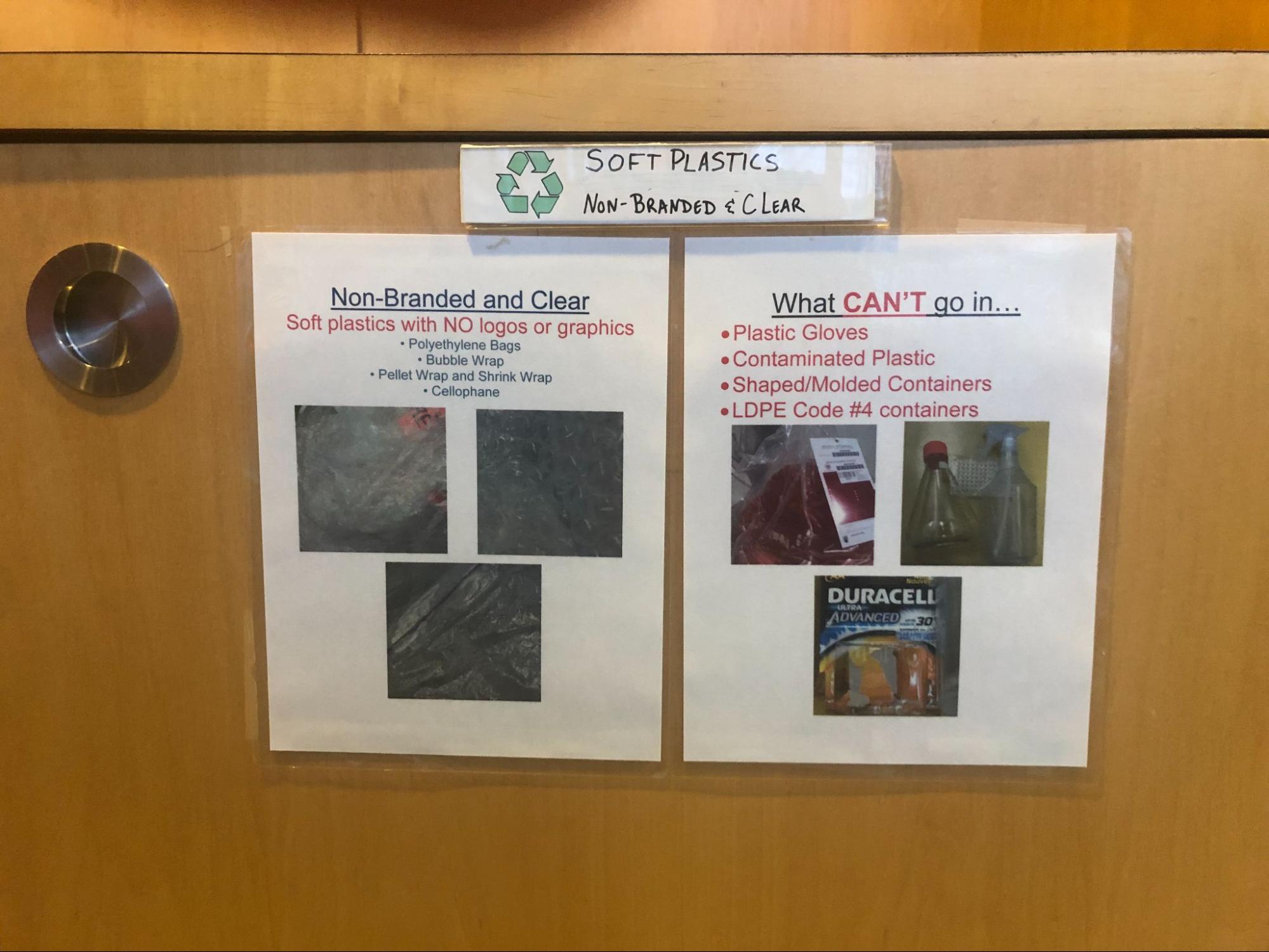
UBC is not taking care of the sorting of these ones in-house, however it has a system in place to pick it up, and the BRC has taken care of this.
You can deposit your bagged styrofoam and your soft plastics in the designated area and municipal services take care of it.
There are two bins located on the ‘ground floor’ of the building for soft plastics. See the pictures below that show what to put and not to put there.
Styrofoam has to be bagged in clear bags and should be left on our loading bay for later pick up.
More general information on this topic can be found in this link.
E-waste
BRC has a large cage for it, located just before the exit of the building towards the loading bay (room #150). Useful information regarding e-waste accepted items can be found in the link below. Be mindful and avoid bringing here your home items.
https://buildingoperations.ubc.ca/accountability/sustainability/zero-waste/e-waste/

Batteries
We have a box for batteries collection on each floor of the BRC, please read instructions carefully before discarding your batteries. And please, be mindful, and only discard here research related batteries. Please, find alternative pathways for your personal ones.
https://riskmanagement.sites.olt.ubc.ca/files/2019/08/Battery-Disposal.pdf

Hazardous waste disposal
The first step is enrolling here:
https://hwis.srs.ubc.ca/wis/login.aspx
Taking this online 30 minutes course on Hazardous Waste Management will be extremely helpful too: https://wpl.ubc.ca/browse/srs/esc/courses/wpl-srs-hwmt
After that, you will be ready to dispose of your solid/liquid hazardous waste.
There is a lot of general information (see links below) about the different types of waste
Hazardous Waste Information Sheet

Repeated liquid solvents waste
Often in the lab you perform routine procedures that give place to liters and liters of solvent liquid waste. In that case, the UBC office of environmental services from safety and risk services, provides the following simple guidelines.
- Collect your waste in either Halogenated or Non-halogenated separated containers
- When full, transfer to the reusable containers offered by srs making sure no solids are present
- Bring the full reusable container to the centralized waste storage location at the BRC (near loading bay, you need a key to access this room)
- Attach a BLUE label to the container (label should contain your lab identification sticker with the generator barcode, plus a mark identifying the nature of the waste). Both label and barcode can be requested online through the srs site where your lab has to have an account: https://hwis.srs.ubc.ca/wis/login.aspx
- Pick up an empty reusable container form the centralized waste storage location at the BRC and repeat
Note: if not containers are available, please email Bang Dang, from the Environmental Services office: bang.dang@ubc.ca
This is a picture of approved containers (5L and 20L) to discard this type of waste. In addition, they require a blue tag attached to them.

Finally, if you have an item to discard and are unsure how/where, you can try your luck here: A-Z Recyclopedia